EnduRAI (Human-centric Multimodal Augmentation in Manufacturing with sEMG and AI) is a European research project developing next-generation technologies to improve worker well-being, safety, and productivity in manufacturing. By combining advanced biosensing with artificial intelligence, the project places people at the centre of industrial innovation, in line with the vision of Industry 5.0.
Project Vision
Manufacturing is undergoing rapid transformation, driven by automation, digitalisation, and increasing complexity. However, many current technologies focus on machines rather than people, often leading to physical strain, cognitive overload, and limited inclusivity for workers.
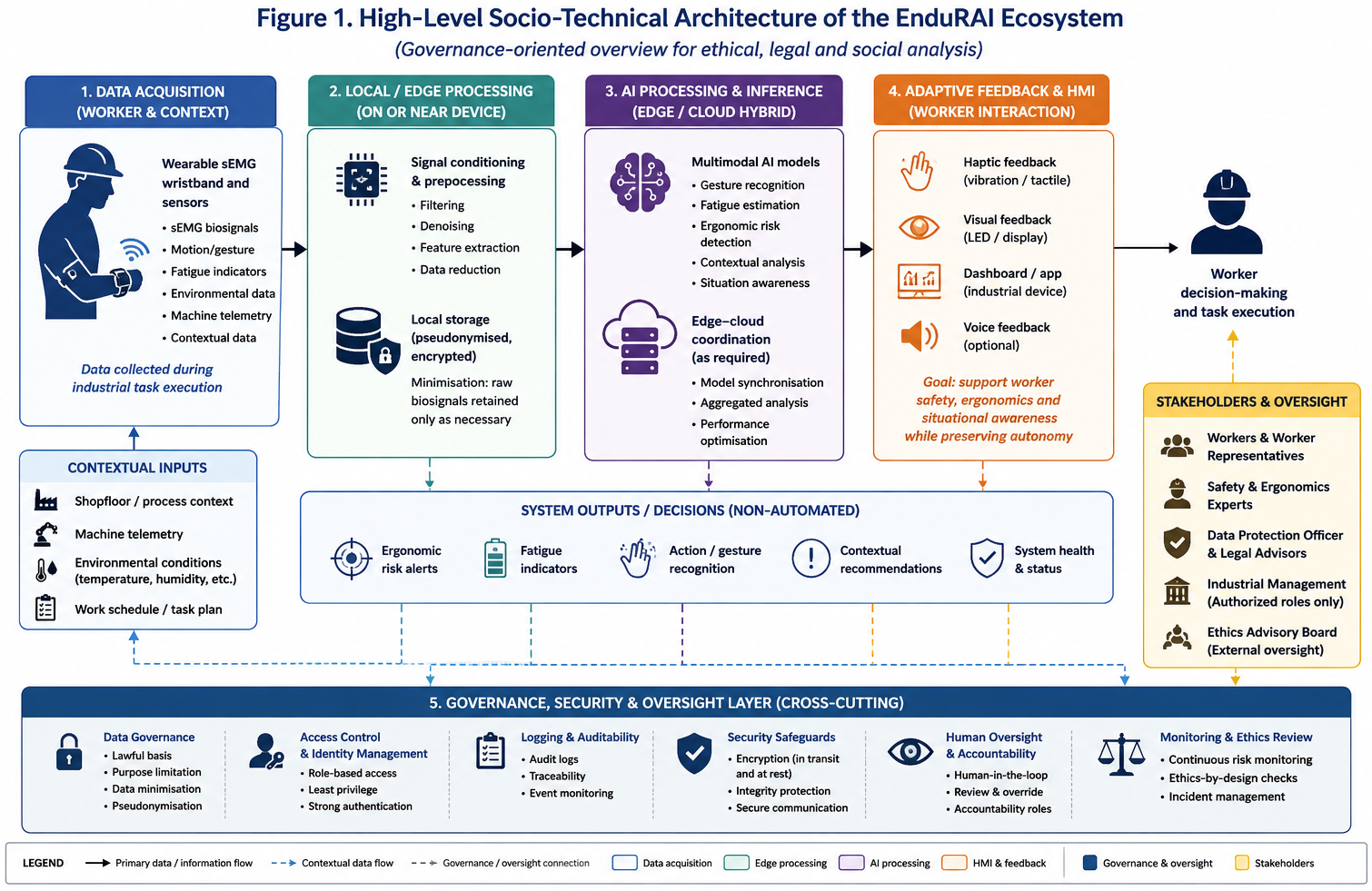
EnduRAI addresses this gap by developing a human-centric augmentation platform that supports workers in real time. The system integrates:
- surface electromyography (sEMG) sensors to capture neuromuscular activity
- multimodal AI models combining biosignals with shopfloor data
- adaptive interfaces and decision-support tools
This enables both, physical augmentation (fatigue detection, ergonomic support) and cognitive augmentation (decision guidance, adaptive workflows). The result is a new generation of intelligent systems that enhance performance while respecting human dignity, diversity, and well-being.
Core Innovation Pillars
1. Human-Centric Biosensing with sEMG
EnduRAI introduces novel wearable sensors that measure muscle activity in real time. These signals provide insights into fatigue, stress, and worker intention—allowing early detection of risks and more intuitive human–machine interaction.
2. Multimodal AI for Worker Augmentation
By combining biosignals with production data, EnduRAI develops AI models that understand both the worker and the environment. This enables:
- context-aware decision support
- adaptive workflows
- reduced cognitive load
3. Participatory Co-Design and Inclusivity
EnduRAI integrates Social Sciences and Humanities (SSH) throughout the project. Workers, managers, and experts are actively involved in design and validation, ensuring:
- usability across diverse workforce groups
- gender and inclusivity considerations
- trust and acceptance in real industrial settings
Impact
EnduRAI contributes to the twin transition (green and digital) by:
- improving worker health and safety
- increasing productivity and industrial resilience
- enhancing job attractiveness in manufacturing
- supporting inclusive and human-centric workplaces
The project demonstrates how AI and advanced sensing can empower workers rather than replace them, shaping a sustainable and competitive European industry.
Funding
EnduRAI is funded under the European Commission Horizon Europe programme, topic HORIZON-CL4-INDUSTRY-2025-01-TWIN-TRANSITION-02.
ZSI’s Role
The Centre for Social Innovation contributes its expertise in:
- participatory co-design
- human-centred evaluation
- inclusivity and ethics
- SSH integration in industrial innovation
ZSI ensures that EnduRAI technologies are not only technically advanced but also socially robust, inclusive, and aligned with European values.
Disclaimer: Views and opinions expressed are however those of the author(s) only and do not necessarily reflect those of the European Union or the granting authority (HADEA). Neither the European Union nor the granting authority can be held responsible for them.